
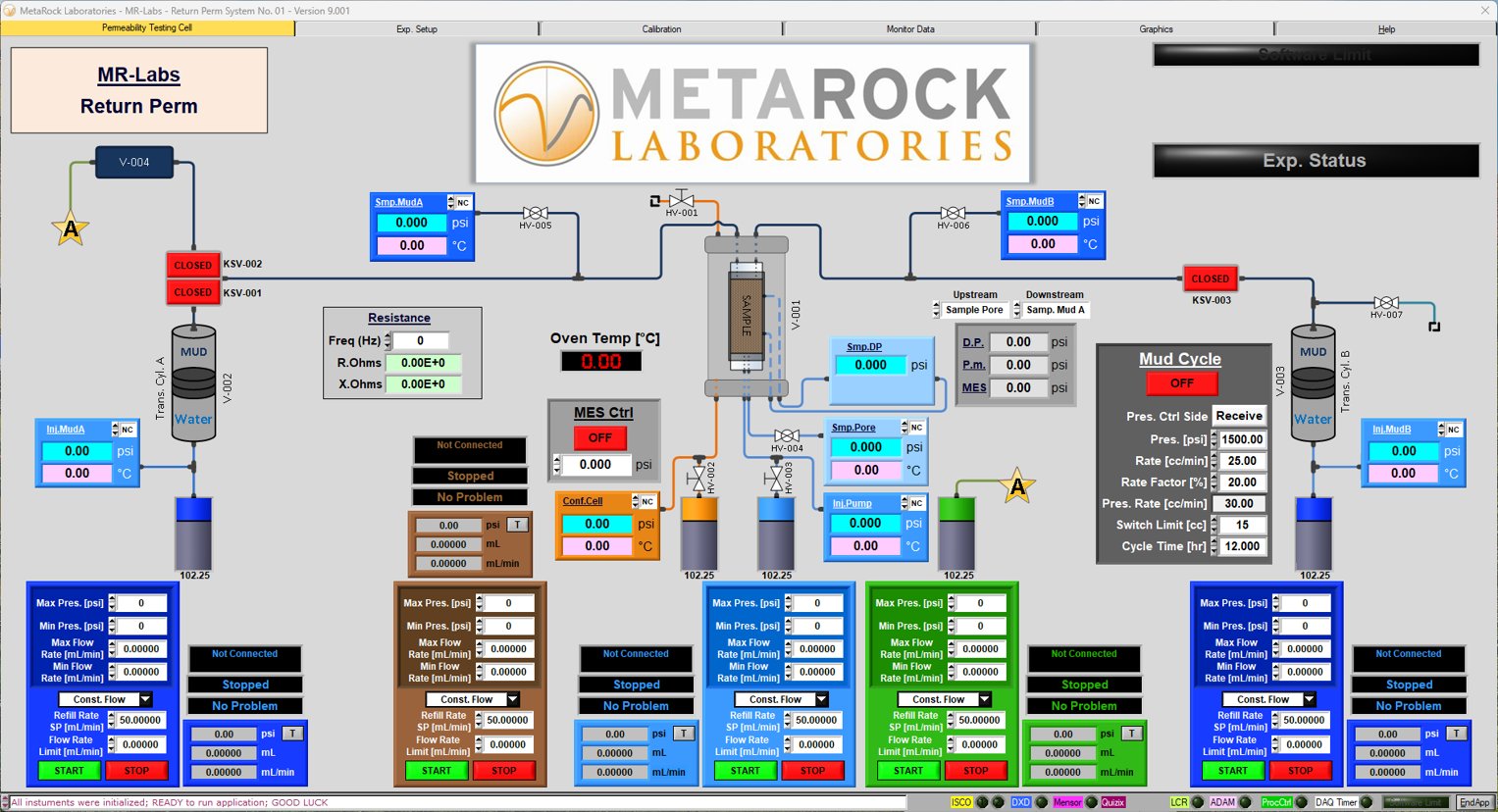
Return Permeability System
Formation Damage Testing SystemA system designed to study the effect of drilling mud on the permeability of wellbore rocks, investigating mud-rock interactions including permeability drop, filtrate penetration rate, and lift-off pressure of the mud filter cake.
Flow Configuration
- Designed to allow both bottom-to-top flow and reverse flow through the rock sample
Mud Exposure Pathway
- Specific pathway leading to one end of the rock sample designed for mud exposure
- Allows mud cycling across one face of the rock sample, exposing it to moving mud at a specified temperature for extended periods
- Smooth mud flow at higher rates; pathway can be isolated from downstream during mud cycling to avoid contaminating the pumps with mud
Differential Pressure Measurement
- Side tap differential pressure measurement in addition to standard upstream/downstream differential pressure measurement
- Enables permeability measurement across a portion in the center of the sample and across the whole sample
| General | |
| Maximum temperature limit | 150°C |
| Room Temperature Operation | |
| Confining pressure limit | 10,000 psi |
| Pore pressure limit | 7,500 psi |
| Reservoir Temperature Operation | |
| Confining pressure limit | 7,000 psi |
| Pore pressure limit | 2,500 psi |
System Components
- 1 confining pump for maintaining confining pressure around the sample
- 1 pressure vessel to hold the sample and allow room for circulating mud across the sample face
- 2 pore pumps for measuring permeability at constant pressure
- 2 transfer cylinders for mud circulation across the face of the sample
- 2 mud pumps to drive the transfer cylinders while maintaining constant pressure and flow rate
- 7 pressure transducers to read pressure across multiple components of the system
- 3 solenoid valves to control the flow of pore fluid and mud within the system
- 1 Rosemount differential pressure transmitter to read differential pressure across the side taps
Pump Control
- Full control of all pumps and their operating modes
Automation
- Mean effective confining stress automation — confining pump responds to pore pressure to maintain constant mean effective confining stress for the duration of the test
- Mud circulation automation — mud pumps drive the transfer cylinders back and forth to cycle mud across one face of the sample
- Mud circulation is fully customizable: desired pressure, flowrate, time period, and pump re-stroke limits
Data Acquisition
- Real-time data monitoring for all system components
- Data acquisition from all pumps and pressure transducers
- Calculated values: differential pressure, effective pressure, mean pressure, and permeability
Drilling Mud Optimization
- Testing with standard representative core for optimization of individual mud designs
Formation Damage Analysis
- Investigation of selected mud on formation rock permeability
Market Benchmarking & Validation
- Benchmarking and comparative analysis on standard and reservoir rock for selection of optimal mud
- Can be paired with other tests such as pressure transmission tests for a holistic evaluation
Hardware Safety Limits
- Safety limits embedded within the pumps
- User-defined safety pressure threshold — pump stops immediately when the set pressure is reached
Software Safety Limits
- Monitors each pressure transducer and shuts down all pumps if the safety pressure is exceeded
- Safety limits are user-defined per pressure transducer and can also be applied per pump
Fill in your details to receive the product brochure.
Related Products
Two-Phase Relative Permeability System
Two-phase core flood system with in-situ X-Ray monitoring for steady-state and unsteady-state measurements.
View Product →Multiphase Relative Permeability System
Three-phase automated core flood system for relative permeability measurements under in-situ conditions.
View Product →Multicell Porosity and Permeability Rigs
High-precision multicell systems for porosity and permeability measurements on multiple core samples simultaneously.
View Product →CoreInsight-V4 (SCAL System)
Advanced SCAL system for high-precision reservoir characterization including electrical resistivity and pore volume measurements.
View Product →Permeability Systems
Modular steady-state, unsteady-state, and ultra-low permeability measurement systems for a range of core analysis applications.
View Product →