
Rock Mechanics Testing
Azimuthal Radial Acoustic Velocity Testing
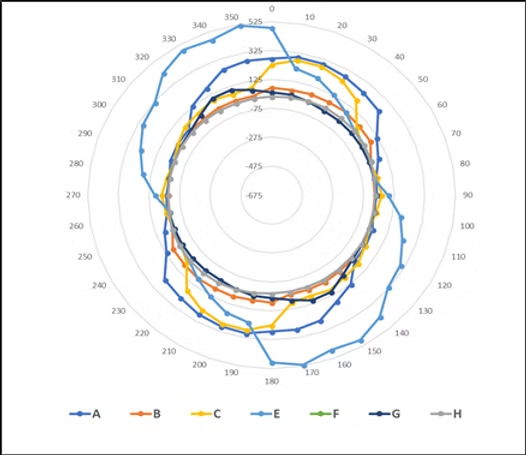
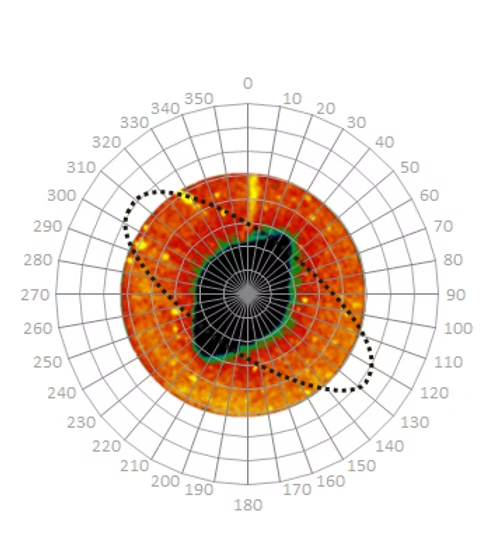
Rock retains a “stress memory”. Quantifying strain recovery in drilled core through azimuthal acoustic velocity measurement allows in-situ stress to be estimated without an expensive in-situ test.
What you receive
- In-situ stress orientation from strain relaxation
- P-wave or S-wave velocity across the sample
- Unstressed measurement at 1° intervals
- Stressed measurement at 45° intervals, any stress path
- Whole core or plug for unstressed work
Unstressed: 1″ to 4″ diameter, plug or whole core, 1° interval. Stressed: 1″ to 1.5″ diameter, plug only, 45° interval.
- Compared with in-situ hydraulic fracturing tests, and with laboratory techniques using acoustic emissions, DSCA or ASR, monitoring the change in ultrasonic properties as the core relaxes is a viable and considerably cheaper alternative.
- The sample is mounted on a rotary table and P or S-wave velocity is transmitted across it as the sample turns.
- The setup rotates the sample in steps as fine as 1° and moves the acoustic transducer vertically in increments of 0.025 mm, so the azimuthal variation is well sampled.
- The same measurement can be made under stress along any stress path using a radial ring, though the ring restricts acquisition to every 45° and works on plug samples only.