
Rock Mechanics Testing
UPVC (Uniaxial Strain Tests)
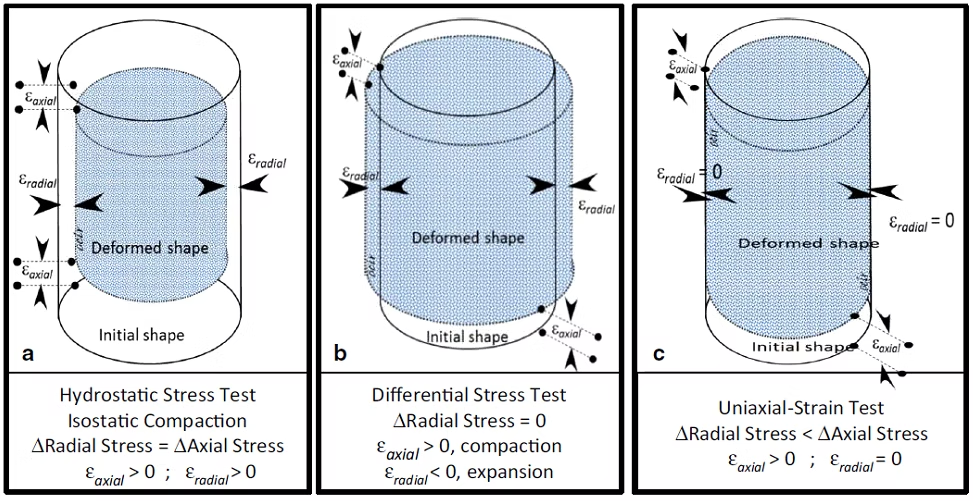
Depletion and injection cause volumetric deformation in the subsurface, and in the field that deformation is largely uniaxial because the reservoir is laterally confined by the bounding strata. UPVC replicates that in the laboratory by holding lateral strain at zero.
What you receive
- Matrix and pore volume compressibility
- Measurement under zero radial strain and constant overburden
- Ultrasonic velocities throughout (Vp, Vs1, Vs2, Vp45)
- Anisotropic permeability (KV, KH) as a function of stress
- Data toward the complete failure envelope
- Run to the ISRM Suggested Method
Sample dimensions: 1″ × 2″ or 1.5″ × 3″.
- Compressibility of the rock matrix and of the pore space feeds directly into permeability estimates, original hydrocarbon in place, reservoir pressure management, production planning, and anticipating compaction and subsidence.
- Getting it from a uniaxial test rather than an isotropic one matters because uniaxial is what the reservoir actually experiences.
- Deformation can be replicated under pore pressure depletion or under effective stress conditions.
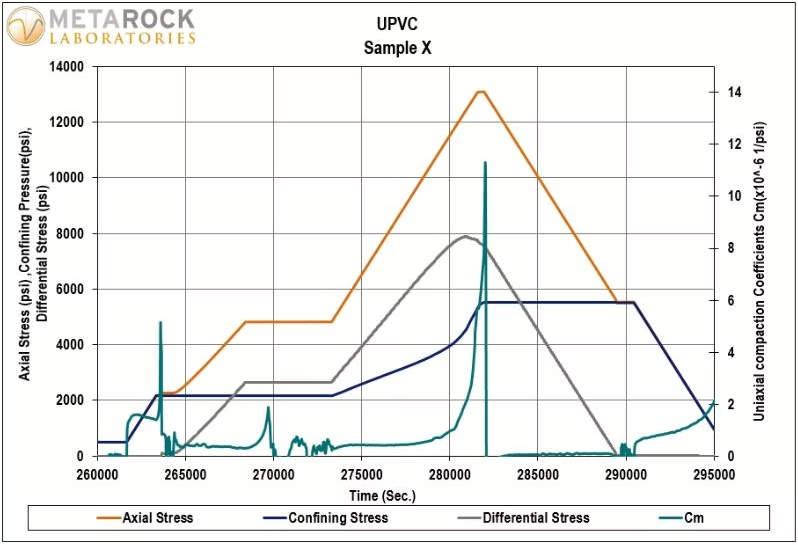
- To simulate compaction, total axial effective stress is raised in discrete steps while confining stress, deviatoric stress, axial strain and ultrasonic velocities are monitored.
- Anisotropic permeability can be measured simultaneously using the MR-FlowQube pump and digital pressure transducers, giving vertical and horizontal permeability as a function of stress across the same experiment.